

How to Make a Witch Altar: A Beginner's Setup Guide
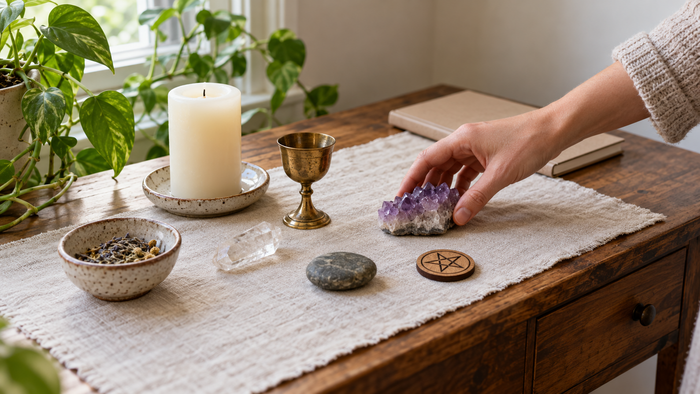
Making a witch altar comes down to six steps: choose your space, cleanse it, lay down a cloth, add tools for the four elements, bring in personal items, and consecrate the finished setup. None of it requires an expensive haul or a perfect room. It just requires a little intention at each step.
If you're still working out what an altar actually is and why witches keep one, our guide to what a witch altar is covers that first. This post picks up from there and walks through building one of your own.
Step 1: Choose Your Space
Start with a flat, stable surface. A small table, a shelf, a windowsill, or even a dresser top all work. Size doesn't matter nearly as much as privacy and consistency. If you share your home and can't dedicate a visible surface, a small tray or box that you set up and pack away each time works just as well as a permanent shelf.
Pick somewhere you won't be interrupted mid-ritual, and somewhere that won't get casually rearranged by roommates, kids, or pets. A closet shelf, a nightstand, or a quiet corner of a bedroom are all common choices for a first altar.
Step 2: Cleanse the Space
Before anything goes on your altar, clear the energy of the spot itself. A few common methods:
Smoke cleansing with rosemary, cedar, or palo santo. White sage is the most talked-about option, but it's worth knowing that wild-harvested white sage has become a documented conservation concern, so rosemary and cedar make good substitutes if you'd rather not add to that pressure.
Sound cleansing with a bell or a singing bowl, letting the tone ring through the space.
Salt cleansing by sprinkling a small line or circle of salt around the surface, then wiping it away.
Any of these takes less than a minute and gives you a clean slate to build on.
Step 3: Add an Altar Cloth
An altar cloth isn't strictly required, but it protects the surface underneath and visually marks the space as separate from everyday use. Pick a color and material that matches your intention:
Black works well for protection and banishing work. Green suits abundance and growth. White fits purity and new beginnings. Purple leans toward psychic and divination work.
Cotton, velvet, and satin are the most common fabric choices, mostly because they lie flat and don't shift around when you're working.
Step 4: Represent the Four Elements
Most altar traditions build around the four elements, each placed in a rough cardinal direction.
Earth (North) is usually a pentacle, a small bowl of salt, or a cluster of grounding crystals. Our altar tools collection carries pentacles sized for smaller altars if you're starting compact.
Air (East) shows up as incense, a small bell, or a wand, tied to intention and clarity.

Fire (South) is almost always a candle. Color matters here too. If you want to match your candle to your intention rather than grabbing whatever's on hand, our candle color meanings guide breaks down which shades suit which kind of work.

Water (West) is typically a small chalice or dish, holding actual water, wine, or moon water.
You don't need elaborate versions of any of these. A stone from your yard, a tea light, and a small cup from your kitchen cabinet cover all four elements without spending a cent.
Step 5: Add Your Personal Tools
Once the elemental basics are in place, add whatever supports your actual practice. Common additions include a journal or grimoire for recording spellwork and observations, tarot or other divination tools, statues or images tied to any deities you work with, and sentimental objects like stones or photographs connected to people or places that matter to you.
If you're deciding between a personal notebook and a more structured reference text for this step, our grimoire vs. Book of Shadows guide breaks down the difference and helps you pick the one that fits how you actually work.
None of this is mandatory. Plenty of witches keep a sparse altar with just a candle and a stone. Others build toward something more layered over months or years.
Step 6: Consecrate Your Altar
Consecrating your altar is optional, but many witches use it to formally dedicate the space to their practice. A simple version:
Light a cleansing incense, such as rosemary or frankincense. Sit with the altar for a moment and let the space settle. Pass the smoke over the surface with intention. Speak a short dedication, something as simple as "I dedicate this space to my practice. May it serve me well."
There's no required wording. What matters is that the words feel honest to you.
Keep Building From Here
A first altar rarely stays the same for long. Tools get added, some get retired, and the whole setup shifts as your practice deepens and the seasons turn. Many witches also build a second, seasonal altar alongside their main one. If Samhain is coming up and you want to build one specifically for it, our guide to setting up a Samhain altar covers the colors, tools, and symbols specific to that sabbat.
Frequently Asked Questions
What do I need to make a witch altar?
At minimum, a flat surface, something for each of the four elements (a stone, incense, a candle, and a small dish of water cover the basics), and a bit of privacy. Everything else is optional.
Can I set up an altar without spending much money?
Yes. A tea light, a stone from outside, a cup from your kitchen, and a stick of incense can represent all four elements without buying anything new.
Do I need to consecrate my altar right away?
No. Many witches use their altar for weeks or months before formally consecrating it, once the space feels fully theirs.
Where should I place my altar?
Anywhere private and stable. A shelf, a nightstand, or a closet all work well, and a portable version works just as well if you don't have a fixed space available.
Ready to start gathering pieces for your own setup? Browse the full altar tools collection for pentacles, chalices, and everything else on this list.